
Alamance Battleground State Historic Site
Located in Alamance County, this site is the location of the Battle of Alamance and offers educational programs and exhibits related to the American Revolution in North Carolina.

Located in Alamance County, this site is the location of the Battle of Alamance and offers educational programs and exhibits related to the American Revolution in North Carolina.
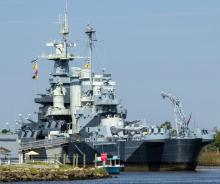
Battleship North Carolina participated in every major naval offensive in the Pacific theater of operations during World War II, earning 15 battle stars. This authentically restored National Historic Landmark proudly serves as her State’s World War II Memorial to the 11,000+ North Carolinians who made the ultimate sacrifice.

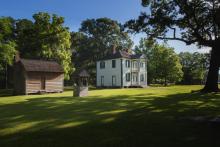
Visit the simple farmhouse that was located between Confederate General Johnston's headquarters in Greensboro and U.S. General Sherman's headquarters in Raleigh, North Carolina in April 1865. The two officers met at the home of James & Nancy Bennett, where they signed surrender papers for southern armies in the Carolinas, Georgia, and Florida.
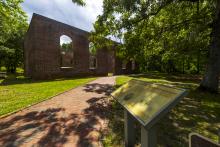
A major pre-Revolutionary port on North Carolina's Cape Fear River, Brunswick was razed by British troops in 1776 and never rebuilt. During the Civil War, Fort Anderson was constructed atop the old village site, and served as part of the Cape Fear River defenses below Wilmington before the fall of the Confederacy.

Founded in 1902 by Dr. Charlotte Hawkins Brown, Palmer Memorial Institute transformed the lives of nearly 2,000 African American students. Today, the campus provides the setting where visitors can explore the place where boys and girls lived and learned during the greater part of the 20th century. The museum links Dr.
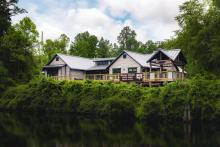
Dismal Swamp State Park offers access to the Great Dismal Swamp, the largest remaining swamp in the eastern United States. Here, you can paddle along the 22-mile Dismal Swamp Canal, a popular destination that hosts the annual Paddle for the Border event. The park's unique plant life, wildlife, and rich cultural history make it a fascinating first stop.
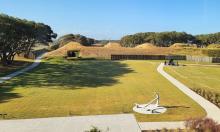
Until the last few months of the Civil War, Fort Fisher kept North Carolina's port of Wilmington open to blockade-runners supplying necessary goods to Confederate armies inland. By 1865, the supply line through Wilmington was the last remaining supply route open to Robert E. Lee's Army of Northern Virginia. When Ft. Fisher fell after a massive U.S.
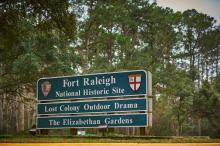
Amongst the shallow blue waters of the Outer Banks lies Fort Raleigh on Roanoke Island. Shaped by constant winds of change, Fort Raleigh has become a focal point of American history.
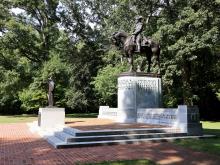
Fought in 1781, The Battle of Guilford Courthouse was a turning point in the American Revolution. At the Guilford Courthouse National Military Park, you can visit significant spots like the Fisher’s Hornets Monument and Colonel Greene Monument.
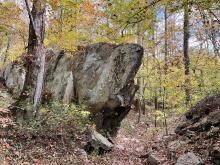
Located in the southeast corner of Rockingham County, served as a general headquarters for Nathanael Greene before the Battle of Guilford Courthouse. The site offers easy hiking, access to the Haw River and Haw River State Trail, and educational signage highlighting the American Revolution.
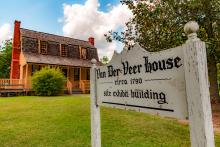
Historic Bath, North Carolina's first town, founded in 1705. This small town was once a bustling port and considered for the colony's capital in 1746. Today, Bath's historic district preserves its early European settlement roots, political rivalries, Indian wars, and piracy tales.

Featuring 18th and 19th century history, North Carolina's second oldest town Edenton was one of the fledgling nation's chief political, cultural, and commercial centers. The state's first colonial capital, it was established in the late 17th century and incorporated in 1722.

Located on the Roanoke River, the town of Halifax evolved into a commercial and political center during the American Revolution. North Carolina's Fourth Provincial Congress met in Halifax in the spring of 1776.
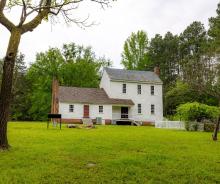
In 1860, Stagville was part of a vast plantation where the Bennehan and Cameron families enslaved over nine hundred people. Once one of the largest plantations in North Carolina, Historic Stagville now inspires new understanding about the history of slavery through preservation, interpretation, research, genealogy, and descendant engagement.