
North Carolina’s degree of religious freedom attracted Quakers, who were among the first British settlers to arrive in the colony, beginning in 1672. Early Quaker communities flourished in the Albemarle region, especially Pasquotank and Perquimans Counties. Later, in the mid-1700s, some Quakers began migrating west to Guilford and other Piedmont Counties. Others moved down the Great Wagon Road from Pennsylvania to the Piedmont, along with German-speaking Moravians, Mennonites, and Dunkers. These groups all shared the ideal of pacifism. During the Revolution, leaders of the new state had some tolerance for the dissenting groups and did not force their men to fight in the war. In return for exemptions from militia service, however, the General Assembly imposed higher taxes on them. State leaders also altered the “Oath of Allegiance” for the dissenting groups to an “Affirmation of Fidelity,” in hopes the word change would be acceptable to those whose religious beliefs prevented taking oaths.
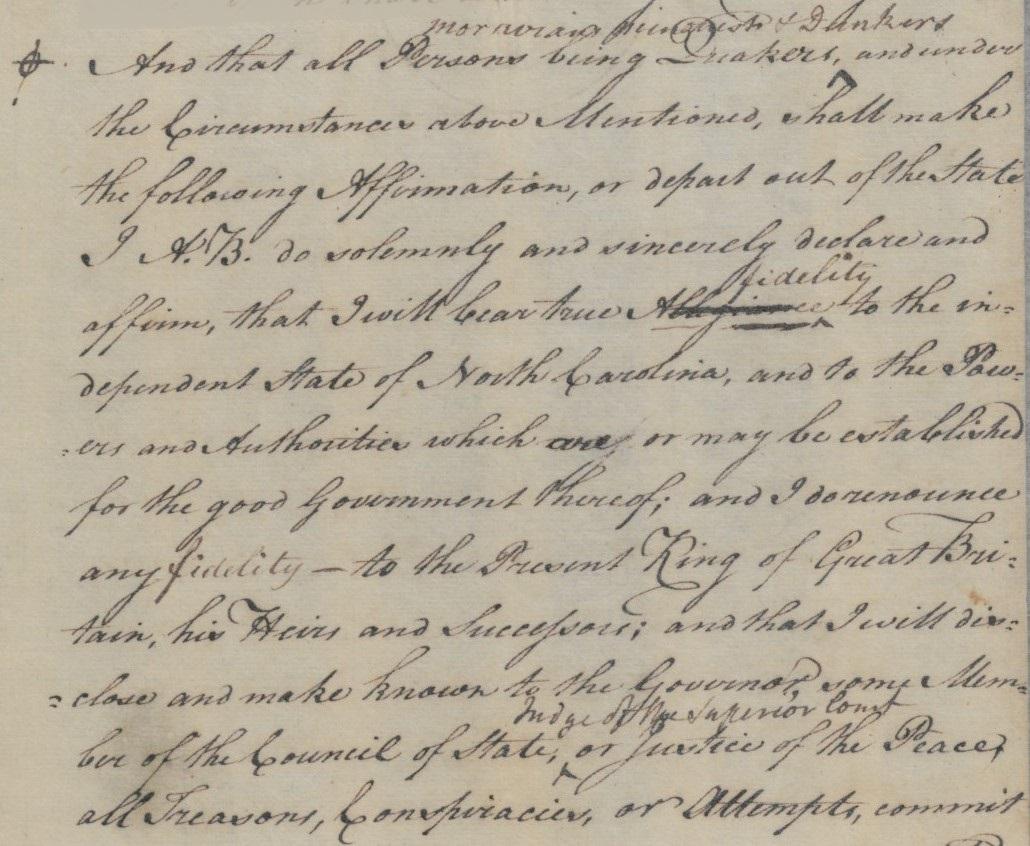
Through petitions and other forms of communication with the new government, dissenting groups pushed to change state laws. The Quakers refused to take the new pledge and wrote in a 1779 petition to the General Assembly,
“we are in Duty bound Gratefully to acknowledge your Lenity … Altering the word Allegiance to Fidelity, to soften the former [oath] and make it easier to us, yet, we think it remains the same in Substance and being enjoined by our Peaceable Principles to live as much as in us Lies a Quiet, Honest, and inoffensive Life, and, to Keep clear from Joining with any Party Engaged in disputes that are to be Determined by Military force.”
North Carolina Quakers dissented further by actively opposing the slave trade, at times emancipating people they enslaved. The General Assembly reacted with laws limiting emancipation, or manumission. For example, the Quaker communities in Pasquotank and Perquimans Counties fought court battles to prevent the re-sale of enslaved persons they had previously attempted to emancipate. State leaders, many of whom owned plantations and enslaved people, protected the slavery system to maintain order and the cash crop economy. As a result, tension between Quakers and the state continued to grow and tested the limits of the young nation’s founding ideals.
Check out more primary sources concerning the dissenting groups and legal challenges from the State Archives of NC:
- Moravian petition regarding the Oath of Fidelity, August 1778, General Assembly Session Records, Joint Select Committees, box 1, folder 7, State Archives of N.C.
- Quaker petition regarding the Oath of Fidelity, January 1779, General Assembly Session Records, Joint Select Committees, box 1, folder 8, State Archives of N.C.
- Legislative committee response to the Quaker and Moravian petitions, January 1779, General Assembly Session Records, Joint Select Committees, box 1, folder 8, State Archives of N.C.
- Report of the Committee…related to the Slaves liberated by the Quakers, General Assembly Session Records, Joint Select Committees, box 1, folder 8, State Archives of N.C.
- Quaker petition regarding emancipation, April 26, 1782, General Assembly Session Records, Joint Select Committee Reports and Papers, box 1, folder 8, State Archives of N.C.
- Learn more about “Quakers in Revolutionary North Carolina” from Mosaic NC.