
Once the 1st Provincial Congress published resolves to protest Great Britain’s actions in 1774, citizens felt growing pressure to choose a side. Would they support the Patriots, or “rebels,” or would they support the Crown? Those who remained loyal to Great Britain were known as “Tories” or Loyalists. In May 1775, a Patriot mob of protesters surrounded the royal governor’s palace at New Bern, and the governor—Josiah Martin—fled the capital at night, eventually seeking safety at Fort Johnston, near the mouth of the Cape Fear River. Martin believed many North Carolinians would remain loyal and would rally to defend him and the Crown. The initial support he gathered soon disintegrated.
Those who did remain loyal included some Highland Scots, who had settled along the Cape Fear River, spanning from Wilmington west to Cross Creek (later named Fayetteville) and even further into the backcountry of the Sandhills. Many of this group had immigrated to North Carolina in recent years and felt gratitude for land grants from the Royal government and responsibility to stay true to the loyalty pledges they had made to the King of England upon accepting land. After the defeat of a force of mostly Highland Scots at the Battle of Moores Creek Bridge in February 1775, Loyalist support in that region dwindled. Those who would not take the Oath of Abjuration and Allegiance to the new North Carolina government were forced out of the state or imprisoned. The state also confiscated Loyalists’ property.
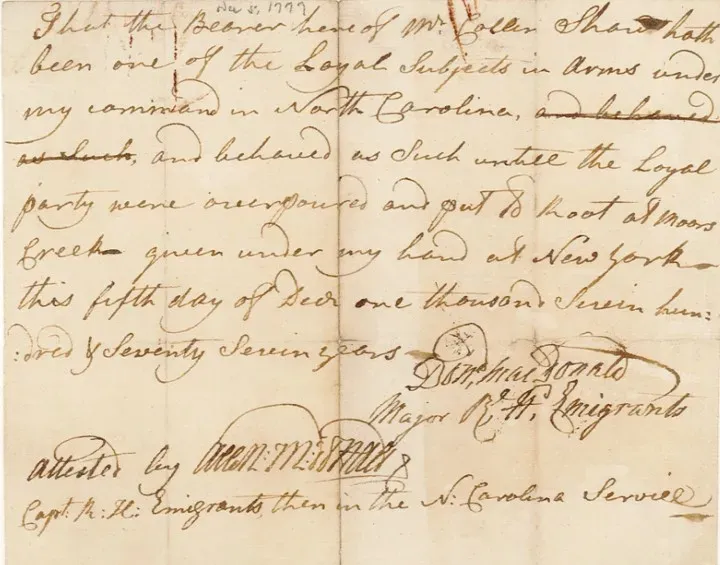
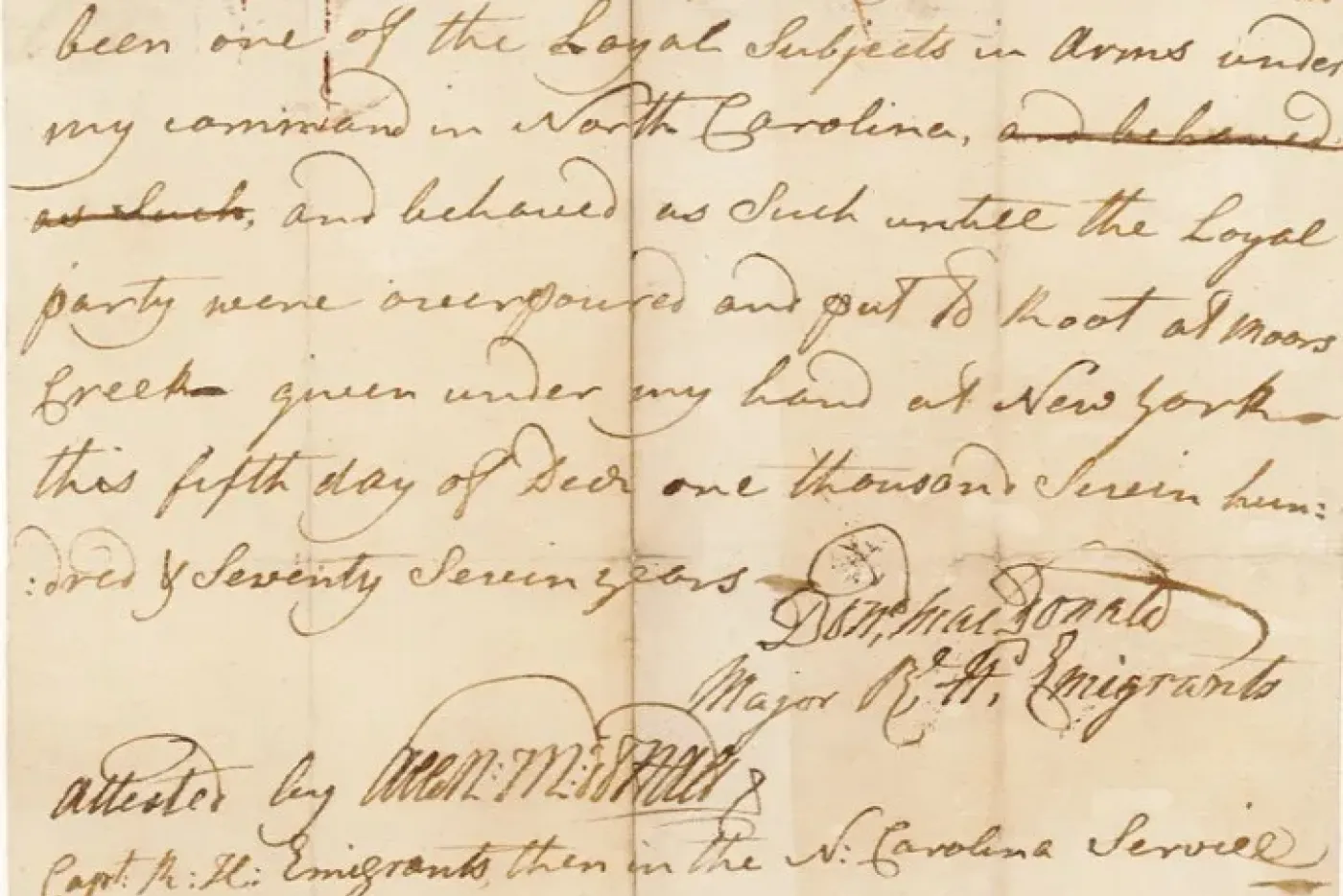
Transcription: That the Bearer here of Mr. Collin Shaw hath been one of the Loyal Subjects in Arms under my command in North Carolina, and behaved as Such until the Loyal party were overpowered and put to shoot at Moors Creek given under my hand at New York this fifth day of Decr one thousand Seven hundred & Seventy Sevin years
Signed “Don^d MacDonald Major R^l H^d. [Royal Highland] Emigrants
Attested by [Allen McDonald?] Capt. R:H: Emigrants, then in the N: Carolina Service
The Colin Shaw Papers (PC.20), tell the story of a Highland Scots family ripped apart by the War. Shaw emigrated from Argyllshire, Scotland in 1744 and settled near Cross Creek. After fighting as a Loyalist at the Battle of Moores Creek in 1776, Shaw refused to take the Oath of Allegiance to the new state the following year, and Patriot leaders forced him to leave. He set sail from New Bern in October 1777, leaving behind his wife Salley and four children—Malley, Christian, Neil, and Collin [spelling based on his letter dated Oct. 8, 1778]. A year later he was living in New York and a brief flag of truce between the Continentals and the British army motivated him to write to his wife his hope “that we all go home in peace if not I must [come] for you before Long at [any] Rate for you most know that I am troubled in mind to be from you and the Children So Long.”
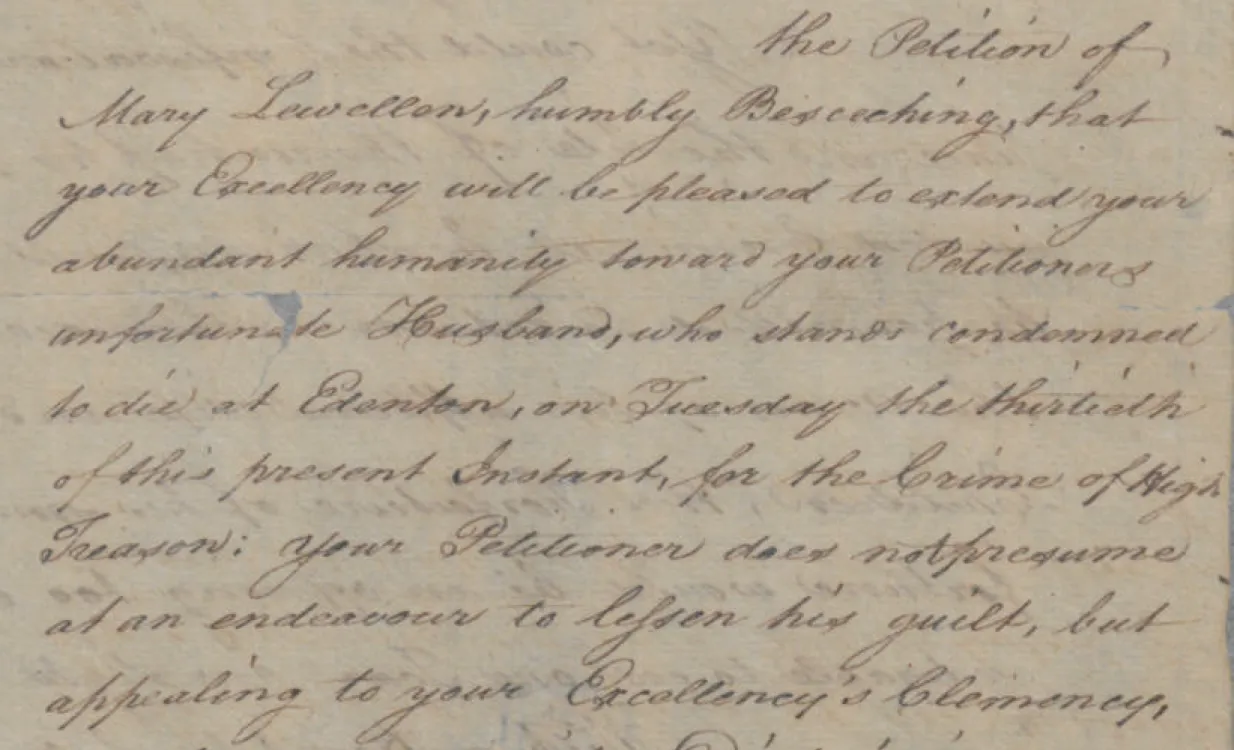
Different goals motivated other Loyalists to fight on the King of England’s behalf. In the summer of 1777, John Lewelling [various spellings included “Lewellen”] led a group of Martin, Tyrrell, Pitt, and Bertie County farmers in a conspiracy against the new state government. In an effort to protect the Protestant religion in North Carolina, the men met in a pumpkin patch, formed a secret society, and plotted to assassinate North Carolina’s governor. Although state leaders uncovered the plan and charged Lewelling with treason, Governor Richard Caswell chose to heed the pleas of John’s wife Mary and issued his first pardon to spare Lewelling’s life.
State Archives staff will share even more fascinating stories of Loyalists and groups seeking neutrality in a free online program, October 7, 2026, noon-1 p.m., “Not All Were Patriots: The Other Side of the American Revolution in North Carolina.”
Explore more:
Oath of Abjuration and Allegiance, “Acts of Assembly of the State of North Carolina,” (New Bern: James Davis, printer, April 1777), p. 13, State Publications Collection, Library of N.C. https://digital.ncdcr.gov/Documents/Detail/acts-of-assembly-of-the-state-of-north-carolina-1777-april/3691851?item=4230218
Colin Shaw Papers, https://digital.ncdcr.gov/collections/revolutionary-war-era?returning=true
Find more about the Shaw family, https://www.ncgenweb.us/cumberland/colinshaw.html
“The Gourd Patch Conspiracy,” online exhibit, https://mosaicnc.org/gourd-patch