
For more than 250 years, people born beyond America's borders have helped shape the United States. Rafael Guastavino was one of them, bringing a distinctive building technique from Spain and eventually making North Carolina his home.
North Carolina holds the grave of a man who came to the state for a single job and stayed for the rest of his life. Rafael Guastavino became one of the most sought-after builders of Gilded Age America, introducing a distinctive system of tiled vaulting to some of the country's most important buildings, including Grand Central Terminal and the Boston Public Library.
Guastavino arrived in New York from Valencia, Spain, in 1881. He traveled with his nine-year-old son, little capital, and a technique few American builders had ever seen. His method used thin terracotta tiles layered in overlapping courses of mortar. The tiles curved upward into arches and domes without any temporary wooden support underneath. Catalan masons called it the timbrel vault. He had spent two decades in Barcelona refining it for the textile mills of industrializing Catalonia before personal and professional setbacks sent him toward America. In 1876, he presented his work at the Centennial Exposition in Philadelphia, where it received a medal. That gave him reason to believe Americans would value his work.
He landed in a country hungry for builders. The Gilded Age was in full swing. Cities were growing fast. Recent fires in cities such as Chicago and Boston had made fire-resistant construction a major concern for American architects. They wanted safer materials. They wanted buildings that would not burn. Guastavino's tile system was fireproof. It was light. It cost less than heavy stone vaulting. Once cured, it formed a rigid shell that behaved much like stone. Using it, his firm built the vaults of the Boston Public Library, the arches beneath Grand Central Terminal, ceilings inside the Cathedral of St. John the Divine, and vaulting in statehouses and churches across dozens of states.
North Carolina entered his life almost by accident. In the early 1890s, architect Richard Morris Hunt brought Guastavino south to work on George Vanderbilt's new Biltmore Estate near Asheville. His tile work still lines the entrance vestibule, the Winter Garden, and the indoor swimming pool. Guastavino was drawn to the mountains and decided to make them his home.
Starting in 1894, he began buying land south of Black Mountain, in Buncombe County, a purchase at a time. By the end of the decade he had assembled more than 600 acres of forest and cove. In 1895 he and his second wife, Francesca, built a rambling three-story wooden house with a bell tower that local residents nicknamed the "Spanish Castle." He called the estate Rhododendron. It had a vineyard, an apple orchard, a dairy, ponds fed by Lakey Creek, and kilns where he kept experimenting with the clay and tile that had made his career. He bottled his own cider under the estate's name and shipped cases of it to friends each winter. Company letterhead from those years still
lists Rhododendron as the business address of a firm that was, at the time, building some of the grandest interiors in the United States.
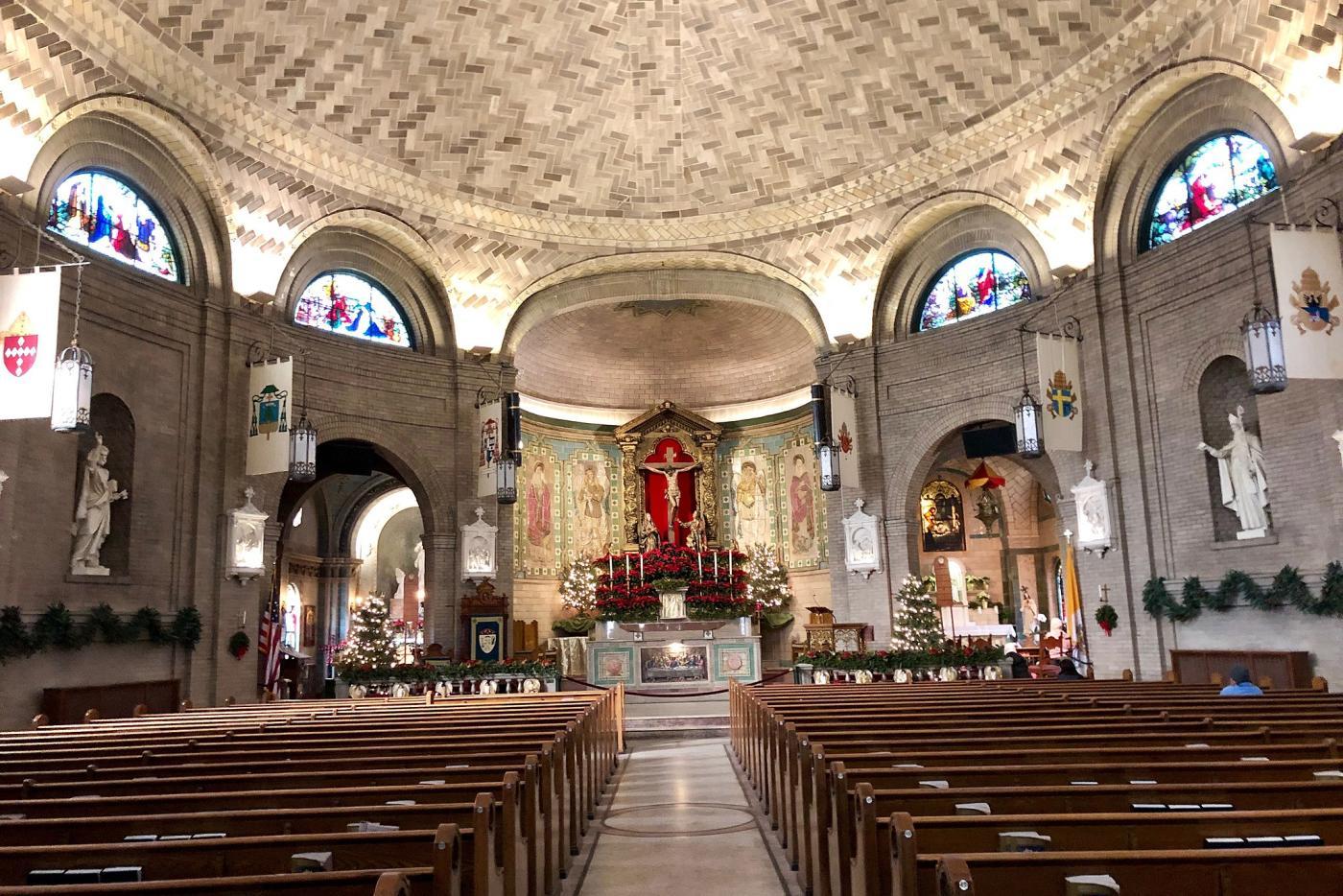
His son ran the New York office. Guastavino stayed in the mountains and kept working. As a Catholic in a region with few Catholic institutions, he became a driving force and major benefactor behind a new church in nearby Asheville. He designed the Basilica of St. Lawrence, completing the plans not long before his death. The building still holds what is considered the largest unsupported elliptical dome in North America. Guastavino built it using the same tile-and-mortar technique he had brought from Europe three decades earlier. In North Carolina alone, his firm's work also went into Duke Chapel in Durham, the Jefferson Standard Building in Greensboro, and churches in Chapel Hill and Wilmington.
Guastavino died at Rhododendron in February 1908, before the basilica's construction was complete. He is buried in a crypt inside it, beneath the dome he designed, in the city where his last major commission still stands. Francesca kept living at the estate until her death in 1946. The house, damaged by fire and left empty, was torn down by the 1950s. The property is now home to Christmount, a Christian retreat center that maintains the surviving kiln, its sixty-foot chimney, the old wine cellar, and stretches of stacked stone wall as a record of the life he built there. In 2021, the state of North Carolina placed a historical marker in Black Mountain in his name.
Guastavino brought a finished craft, trained in Barcelona and tested in New York and Boston, to a corner of the American South he chose because he liked it. Unlike the architects and industrialists who came to the mountains only to build for someone else, he built a home for himself and never left. His firm's tile ceilings eventually covered close to a thousand American buildings, but only one holds his grave. North Carolina was not a stop on the way to somewhere else. It was where Rafael Guastavino chose to make his home, and where his story ultimately came to rest.
By Dmitry Bolkunets, whose research focuses on immigrants who helped shape the United States.
For more information, visit the North Carolina Highway Historical Markers Blog.
Image: Basilica of Saint Lawrence in downtown Asheville, North Carolina