
Local & State History intern Nya Smythe’s research on the courthouse raid in the fall of 2025 was invaluable in the production of this article.
In June 1775, Cumberland County Patriots united together to sign the Liberty Point Resolves.1 Fifty-five men signed the document, promising to unite together and defend North Carolina “against every foe” and “sacrifice our lives and fortunes to secure her freedom and safety.”2 By signing this document, the signers were following the lead of other counties, such as New Hanover County, which had signed a similar document the previous day.3 The document was a response to the start of hostilities with the British at the Battle of Lexington and Concord.4 War had begun in America.
By early 1776, Cumberland County Loyalists gathered at Cross Creek in February 1776 to prepare for battle.5 This culminated with the battle of Moores Creek Bridge, a Patriot victory on February 27, 1776. After this, numerous Loyalists were captured, and the Loyalist movement in Cumberland County died down.6
For a couple of years, the area was quiet. But that was not to last. Starting in the spring of 1781, Loyalist forces started to fight back against the Patriots in the Sandhills region.7 The “Tory War,” as it was known, put Cumberland County in the crosshairs, culminating in a raid on the Cumberland County courthouse on August 14, 1781.
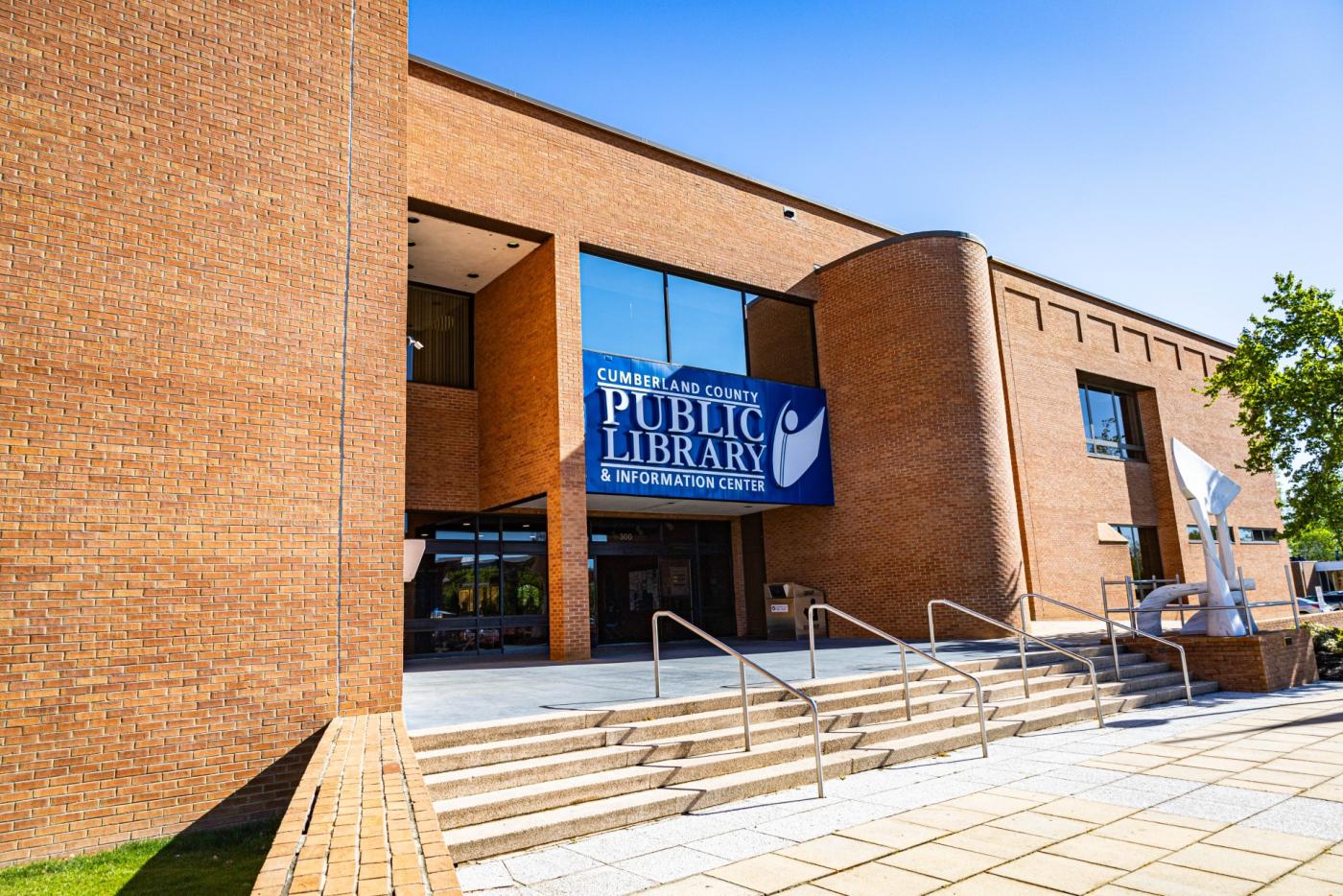
In 1781, the Cumberland County Courthouse was located on Maiden Lane in Cross Creek, on the spot of what is now the Cumberland County Headquarters Library.8 And on August 14, 1781, Cross Creek was raided by a Tory force led by Col. Hector McNeil. Cumberland County militia Colonel James Emmett sent a letter to Governor Burke on August 19, 1781, describing the raid:
“...on Tuesday last, the 14th inst., between 9 and 10 o’clock in the morning, this Town was in the most sudden Manner imaginable surprised by a party of the Enemy under the command of Colns. Kingsby, Ray, and McNeil. They entered the Town in so secret and sudden a Manner that it was out of the Power of any man, who was in it, to make his escape.”9
Other accounts from Lieutenant Colonel Hardy Sanders and John Ramsey confirm that Cross Creek was raided on that day, and Ramsey says that along with Emmet, leading officials such as Robert Rowan, Robert Cochran and Winslow, made up the 50 prisoners captured in the raid.10 After the raid, some of the prisoners were not rescued until the Patriot victory at the battle of Elizabethtown.11
While no primary source account confirms that the Cumberland Courthouse was raided during Col. McNeil’s attack, local legend maintains that it was. Local writers Malcolm Fowler and Roy Parker Jr. both claim that the courthouse was hit during the attack.12 Fowler reports that Alexander Avera rushed into the courthouse as the raid began, and in response to his warning, ”It is said that never before, or since, has the Cumberland Courthouse cleared so quickly and completely.”13 But, as Parker noted, the ”raid was so swift that resistance was impossible, and among the embarrassed officials was Rowan himself, briefly held prisoner by the invaders.”14 Rowan was a significant capture for the Loyalists in the Sandhills region too, as he had been vexing them since 1775, and was a leader of the local Patriot government.15
Further circumstantial evidence that the courthouse was raided is shown in the abstracts of Cumberland County court minutes from the time: both Robert Rowan and Robert Cochran were justices at the July 1780 term for Cumberland.16 At the start of the January 1781 term, Cochran was still on the court, and was also a commissioner for Campbellton.17 There are no court minutes after January 1781 until January 1782, probably because they were destroyed during the Tory War. However, by the 1782 January term, Robert Rowan is a justice again.18 And Alexander Avera, the man who was said to have swept into the courthouse to warn them, was a justice of the court for both January 1781 and January 1782.19 Justices of the peace were usually men of distinction in the community and weren’t term-limited, but served if they had good behavior and were selected by the General Assembly and governor.20 This circumstantial evidence makes it quite likely that if Cochran and Rowan were both captured, then they were both at the courthouse when that happened, which supports the idea that the County Courthouse was raided.21
The reasonable conclusion was that the Cross Creek raid of August 14, 1781, attacked the Cumberland County seat of government- the courthouse. Leading officials were captured, and it took until the Battle of Elizabethtown for the Tory War to finally end in the Sandhills region.
Sources:
- “Association adopted and signed by the Committees of the District of Wilmington, in North-Carolina,” in American Archives: Documents of the American Revolutionary Period, comp. Peter Force, vol. 2, doc. ID S4-V2-P01-sp32-D0392, Northern Illinois University Digital Library, digital.lib.niu.edu/islandora/object/niu-amarch%3A80845.
- “Association adopted and signed by the Committees of the District of Wilmington, in North-Carolina,” in American Archives: Documents of the American Revolutionary Period, comp. Peter Force, vol. 2, doc. ID S4-V2-P01-sp32-D0392, Northern Illinois University Digital Library, digital.lib.niu.edu/islandora/object/niu-amarch%3A80845.
- Local & State History Department, The Voices of Resolve: The Patriots of Liberty Point, (Cumberland County Public Library: 2026), 6-7. Accessible at https://www.cumberlandcountync.gov/departments/library-group/library/america-250-nc#docaccess-411ebacaa2702152ef41dbdd04b91a43.
- Joseph Westendorf, “The Association of Cumberland County, North Carolina,” The Journal of the American Revolution, January 8, 2026, https://allthingsliberty.com/2026/01/the-association-of-cumberland-county-north-carolina/.
- See Colonial & State Records, Vol. 10:452, where Thomas Rutherford called for the King’s subjects to gather at Cross Creek in support of the King on February 13, 1776.
- The Voices of Resolve, 11.
- "David Fanning and the Tory War of 1781," ANCHOR, Library of NC, 2009.
- Bruce Daws, Historic Courthouse Museum Guide (Cumberland County [NC] Cumberland 250th Anniversary Committee). Local and State History Room. Vertical files. Cumberland County Public Library and Information Center. Fayetteville, NC; Cumberland County Deed Book 034, page 233, Cumberland County Register of Deeds; Dan MacMillan, Hay Street to Maiden Lane, 2004, MC.195.F284.2004m, State Archives of NC, Raleigh, NC.
- CSR, 22:566, https://docsouth.unc.edu/csr/index.php/document/csr22-0418.
- For Sanders account, see CSR, 15:612-613, https://docsouth.unc.edu/csr/index.php/document/csr15-0565. For Ramsey’s, see CSR, 22: 570-71, https://docsouth.unc.edu/csr/index.php/document/csr22-0422.
NCDR, ”Battle of Elizabethtown,” December 29, 2023, https://www.dncr.nc.gov/blog/2023/12/29/battle-elizabethtown-i-11.
This article also maintains that the Cumberland County courthouse was hit during the raid of Cross Creek.
- Malcolm Fowler, Valley of the Scots (Wynona Fowler, 1986), 66; Roy Parker Jr, “City owes its existence to revolutionary Patriots”, Observer March 6 2003, p1.
- Fowler, Valley of the Scots, 66.
- Roy Parker Jr, “City owes its existence to revolutionary Patriots”, Observer March 6 2003, p1.
- The Voices of Resolve, 64-69.
- William C. Fields, Abstracts of Minutes of the Court of Pleas and Quarter Sessions of Cumberland County,, Volume 2 (Cumberland County Bicentennial Commission: 1980), 29.
- Fields, Abstracts of Minutes 2: 32, 37.
- Fields, Abstracts of Minutes 2: 40.
- Fields, Abstracts of Minutes 2: 39-40.
- Case, Steven,. Joseph S. Ferrell, and Henry W. Lewis, "Early Beginnings," NCpedia, Library of NC, 2010.
- While Cochran made land transactions in Cross Creek, he appears to have had most of his land on a plot by what is now Cliffdale Road, outside of Cross Creek. So it’s very improbable that he and Rowan were both at their own homes when they were captured, they had to have been together. See Malcolm Fowler Deed Maps, ”Cliffdale Section,” Local and State History Room, Maps, Cumberland County Public Library and Information Center.