
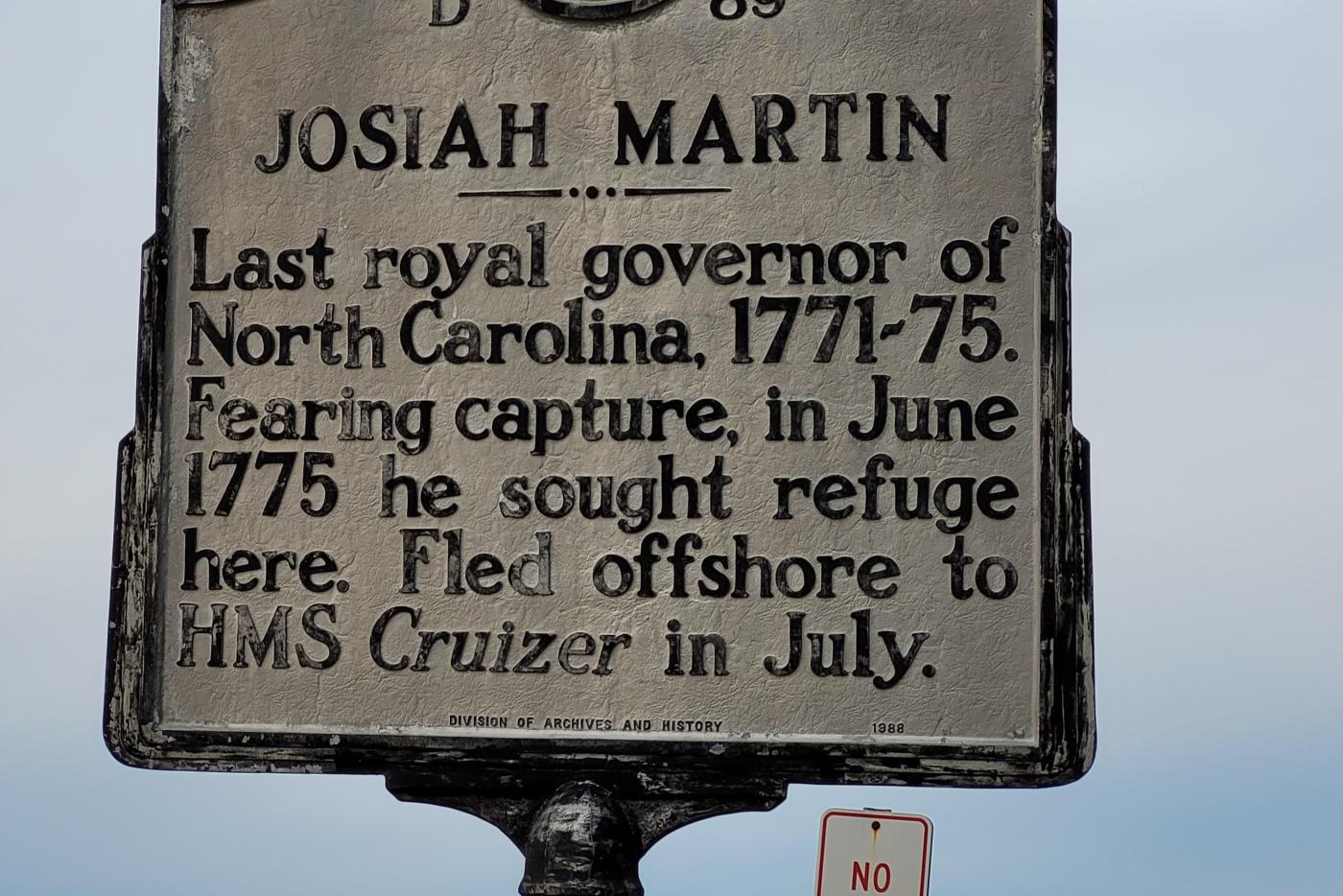
This Worth Knowing post focuses on the HMS Cruizer, a British Navy ship that met a fiery end in 1776 in reaches of the lower Cape Fear, and how its connection to the last Royal Governor of the colony of North Carolina marked a critical moment in our state’s history. As-of-yet undiscovered, the remains of the Cruizer could provide a tangible link to a glimpse of the early stages of the American revolution in North Carolina and is the subject of extensive research by the Office of State Archaeology’s Underwater Archaeology Branch for A250NC.
The Cruizer arrived in North Carolina in 1772, following the fraught final days of the Regulator movement, which culminated in the 1771 Battle of Alamance, pitting dissatisfied colonists against a royal militia. Built in 1752 as the defining ship for a new “cruizer” class of ships, the Cruizer had up till then a relatively undistinguished history as a patrol boat off the southeast British coast, and took up a station in the reaches of the lower Cape Fear. At this point, Cruizer was aged and suffering from lack of maintenance, but yet had made the long journey across the ocean.
Around the time the Cruizer dropped anchor on this side of the Atlantic, Royal Governor William Tryon – noted for his efforts to quell the Regulator rebellion – took his counterpart’s position in New York, and was succeeded in North Carolina by Josiah Martin. Martin’s tenure as new Royal Governor paralleled multiple acts of colonial rebellion, including the consequential Battle of Bunker Hill in Massachusetts in June 1775, seen by many as one of the initiating events of the American Revolution.
Not surprisingly, the British realized the importance of securing the southern colonies, including North Carolina, by sending a convoy of ships to the Cape Fear River led by John Linzee of the HMS Falcon, followed soon after by Commodore Sir Peter Parker in his 50-gun warship, the HMS Bristol.
In the meantime, Royal Governor Martin had sent his family from New Bern to New York for their safety, and fled at night from Tryon Palace in May 1775, moving to Fort Johnston in today’s Southport, North Carolina, with hopes of reconsolidating control over the colony. Patriot forces, however, learned of his new location, and planned an attack. On July 19, 1775, Cornelius Harnett and John Ashe led several hundred militiamen of the New Hanover Committee of Safety to seize Fort Johnston and burn it.
To the Patriots’ dismay, Governor Martin had in fact had already evacuated Fort Johnston a few days earlier to the safety of the decks of the HMS Cruizer, moored nearby.
The crew from the Cruizer did their best to recover anything taken from the fort, such as trucks for the carriages, but later decided it was best to burn what remained of the carriages and spike the remaining guns, throwing them over the wall of the fort. Cruizer spent many of the following days firing on patriot militia in the fort – rounds shot, grape shot, small arms fire, a near constant peppering, up and down the river as well.
By this time, Martin’s plans to summon those loyal to the King were well under way. Martin ordered British General Donald MacDonald and some 1,600 Loyalists to march toward Wilmington in February. General MacDonald eventually encountered Colonel James Moore and his Patriot forces on February 27, 1776. The colonists won what was later dubbed the “Lexington and Concord” of the South, or the Battle of Moore’s Creek Bridge.
The defeat of the Loyalists at the battle of Moore’s Creek Bridge effectively thwarted British plans to subdue North Carolina. By the time British military leaders Generals Parker, Clinton, and Cornwallis arrived in May 1776, they found in Josiah Martin a dejected figure with none of the loyalist forces promised to them. Turning to Charleston, South Carolina as a port of safety, Martin and the British evacuated themselves from North Carolina’s waters, and in doing so, arguably left North Carolina free from British invasion for the next four years. (And Martin is notably the last Royal governor of North Carolina, and succeeded by the first governor chosen by the people – Richard Caswell.)
The British left behind them a small auxiliary fleet including the HMS Cruizer, HMS Falcon, and HMS Scorpion, as well as a small garrison at Fort George on Bald Head Island.
The days of the Cruizer were then numbered. On September 6, 1776, Patriot Colonel Thomas Polk of the 4th North Carolina Regiment assembled 150 men and crossed the inlet to Bald Head Island with plans to attack its Fort George, still held by the British, which had been manned with 30 men but only 12 muskets. Unfortunately, their approach through the woods was discovered by a number of sailors from the Cruizer who ran for cover in the Fort. Hearing the skirmish underway, the HMS Falcon let loose her six pounders into the woods in the direction of Polk’s men, while the Cruizer had four of her 3-pounders mounted on board the HMS Defiance for pursuit. The skirmish ended with one man killed and one wounded on the side of the patriots, with five British sailors captured.
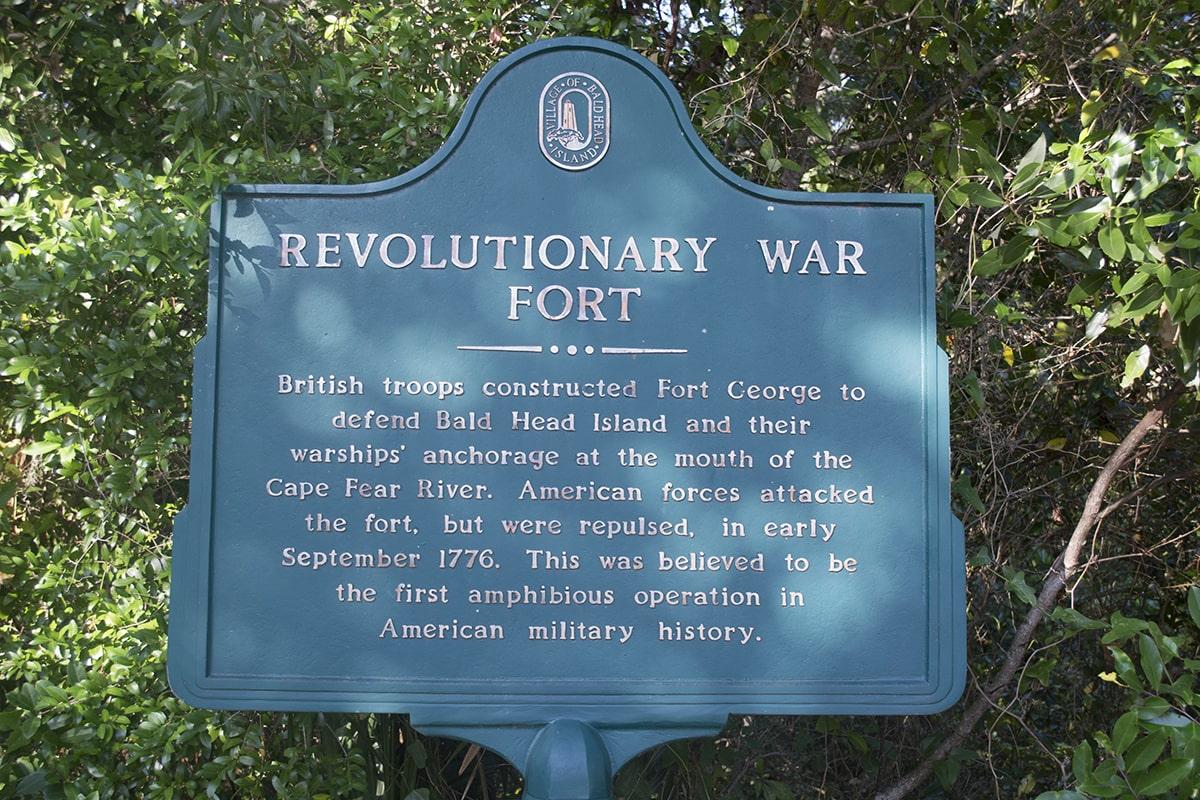
By this time, HMS Falcon together with the remainder of the British fleet which had not yet left for South Carolina received orders to withdraw the garrison at Fort George and return to New York, but with the Cruizer’s pumps constantly running and the steady removal and distribution of her stores, it was clear that she could not make the sea journey to safety. The British themselves burned Fort George on Bald Head Island to prevent its use by the Patriots.
And the Cruizer. after being determined to be no longer fit for service, together the privateer America and two tenders, were stripped and burned, her stores, ordnance, and crew distributed through the squadron for transport. Only Falcon sailed for New York with the officers, crew, and warrant officer’s stores, arriving October 19, 1776.
So why was the Cruizer so decrepit? Even earlier in the year, Cruizer received orders to sail for Boston was unfit to go. Apparently Scottish traveler Janet Schaw even described the Cruizer as “an old sloop of war… covered over with barnacles.” This circumstance was due in part to the ship’s age and the probable lack of a coppered bottom, introducing its hull to teredo worm and other sea life degradation, but also to a lifelong incursion of fresh water. As mentioned earlier, fresh water is essentially the real enemy to all wooden boats, and with twenty years of exposure to English rain before its journey to North America certainly took its toll on the vessel’s knees and frames. Either way, Cruizer’s naval career had come to a close.
Fast forward yet again, this time nearly 250 years later no known efforts to find the Cruizer occurred until 2001, when historian John T. Phillips partnered with the underwater archaeology branch to conduct a magnetometer survey for the HMS Cruizer looking at the ship’s logs as a guide. Phillips did his best to determine the locations of the vessels at anchor that were recording the burning of the Cruizer, as well as attempting to determine where the coastline and channel would have been at the time. The channel, however, is much different than it was back then, due to mechanical dredging activity and nature itself.
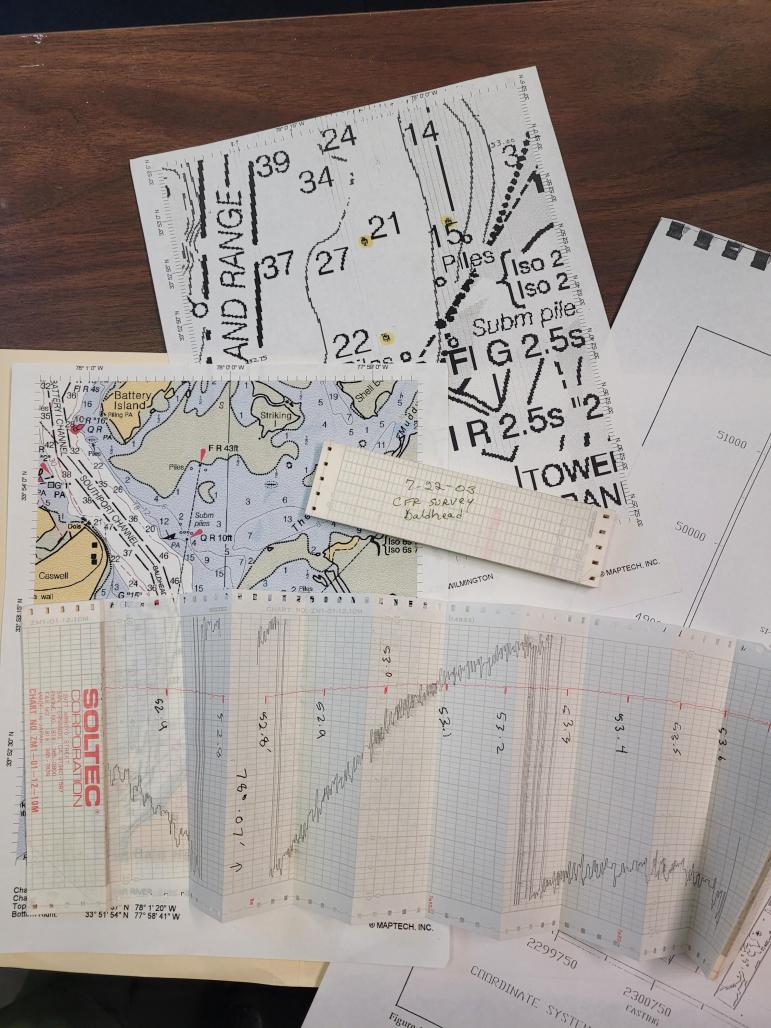
The most recent targeted surveys in this area of the lower Cape Fear River were undertaken by maritime archaeologist Dr. Gordon Watts and Tidewater Atlantic Research in 2014, which produced plenty of magnetic anomalies. Nine of the anomalies found appear to be debris associated with previous navigation range structures. The remaining 25 anomalies unfortunately appeared to have been generated by modern debris.
So, what would even be left to look for? Ships logs indicate that Cruizer was thoroughly stripped of all usable stores, the spars, anchors, blocks, armament, carpenter’s goods, essentially everything that could be of use to any other vessel in the fleet. What would that look like as a site? The images here are of the Rose Hill Wreck, and although it is much smaller than the Cruizer, give a good visual representation of what could be left of an 18th century ship when burned, as this vessel showed evidence of.
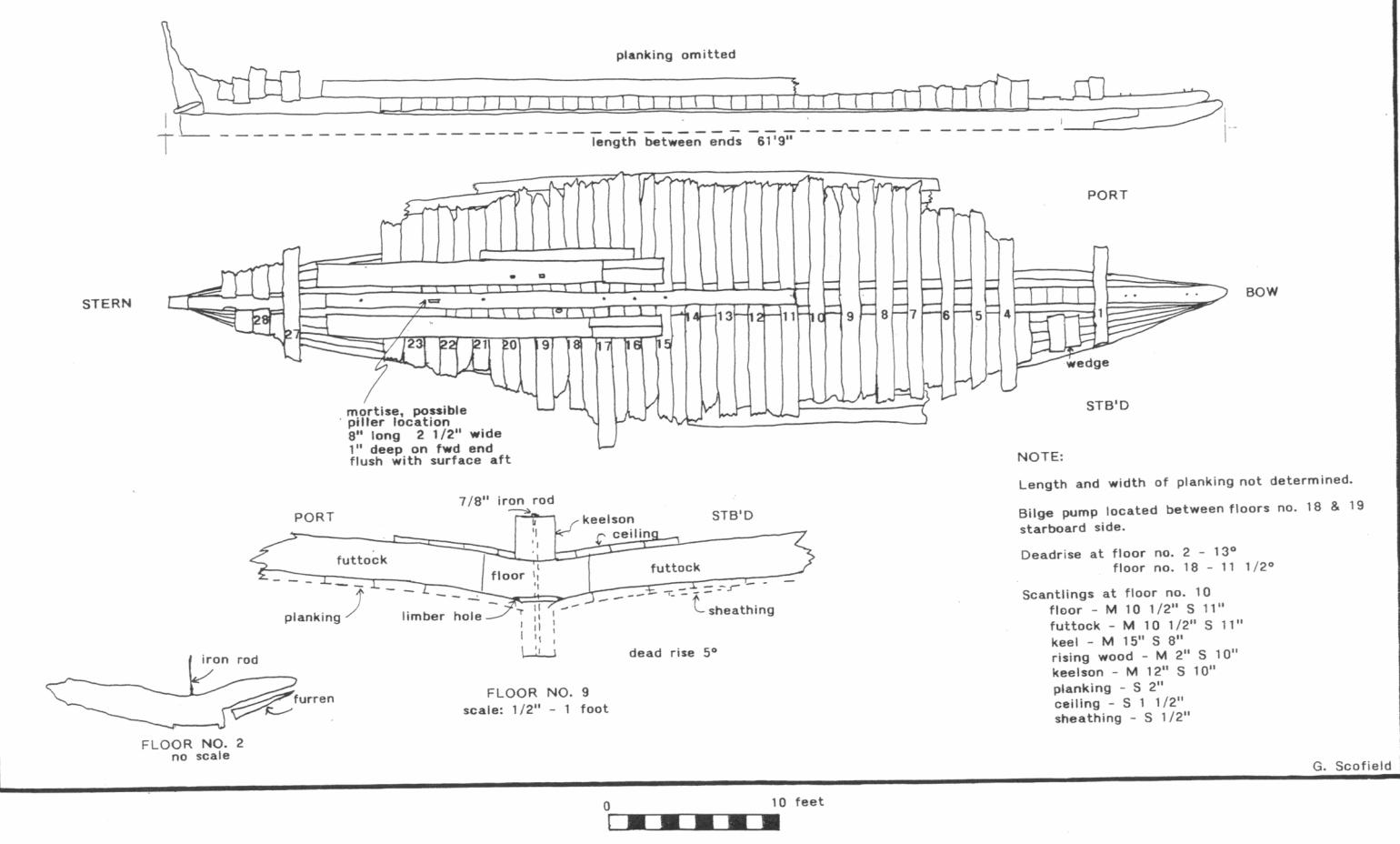
It also gives us an idea of what would be the most plausible way of locating the Cruizer – via magnetometer survey. If the vessel does indeed still exist in this area, its surface relief would be low and it would likely be buried, thus the magnetic signature of its iron fasteners might be our only chance. Phillips’ research shows that there is still a wealth of knowledge to be unlocked from the ships logs of not only the Cruizer but the other vessels in the fleet. The magnetometer data could also be reinterpreted with refinement of the survey area. Locating the wreck of the Cruizer is a continuing project of the North Carolina Office of State Archaeology’s Underwater branch, and one they hope to complete as part of our agency’s initiatives to commemorate America 250 in North Carolina.
More info:
- Royal Governor Josiah Martin state highway historical marker: https://www.dncr.nc.gov/blog/2023/12/11/josiah-martin-d-89
- Vernon O. Stumpf, Josiah Martin: The Last Royal Governor of North Carolina (1986)
- The American Revolution on Bald Head Island: https://www.oldbaldy.org/american-revolution
- Fort Johnston in Southport: https://www.exploresouthportnc.gov/fort_johnston_visitors_center/history.php
- North Carolina Maritime Museum in Southport: https://ncmaritimemuseumsouthport.com/
- Royal Museums at Greenwich (HMS Cruizer plans): https://www.rmg.co.uk/collections/objects/rmgc-object-84758
- Journal of H.M. Sloop Cruizer, Captain Francis Parry, February 24, 1776 / Naval Documents of the American Revolution: https://navydocs.org/node/15664
- Was the Cruizer Captain Cook’s first command? https://www.captaincooksociety.com/cooks-voyages/early-voyages/early-royal-navy-voyages/january-april-1756