
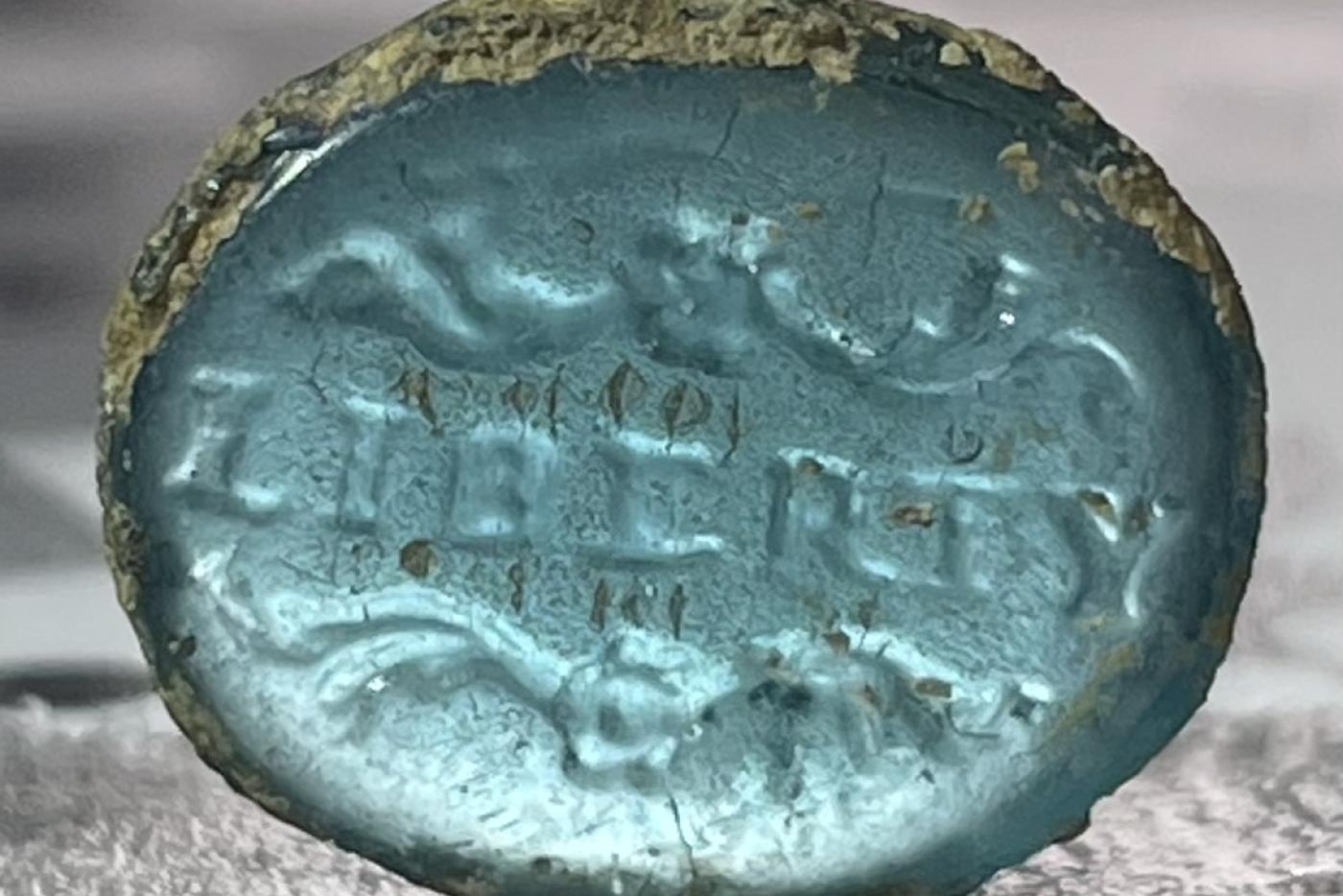
A quiet means to support Liberty from the Revolutionary War era can be found throughout the world, and archaeological discoveries in North Carolina bear out this phenomenon.
First, the story of David Caldwell, a carpenter, Presbyterian minister, and staunch supporter of independence for the American colonies under British control. In what is now Greensboro in Guilford County, Caldwell established his “Log College” in 1767 at his log cabin home, offering a classical education to the young men of the rural Piedmont. Caldwell served as a member of the 1776 Provincial Congress at Halifax that met to draft the colony’s North Carolina Constitution, and in 1788 was a delegate to the Hillsborough Convention where the new United States Constitution was debated.
Caldwell’s legacy of independence adds intrigue to a seemingly ordinary pair of men’s cufflinks discovered during the 1979 excavation of the archaeological remains of the structure believed to be his log cabin. These blue glass cufflinks intriguingly display the word “Liberty”.
In 2019, archaeological students with East Carolina University’s summer field school found a similar cufflink in what had been a town tavern at the Brunswick Town / Fort Anderson State Historic Site. The Brunswick Town cufflink reads “Wilkes and Liberty 45,” referencing a well-known campaign in opposition of King George III that made its way from England to the American Colonies, and which usually indicated the wearer’s support of greater American independence from the British Crown. “Wilkes and Liberty 45” more specifically is linked to John Wilkes, a member of the English parliament and critic of the King, most strikingly in issue 45 of Wilkes’ magazine The North Briton from 1763.
Cufflinks like those found at Caldwell Log College and Brunswick Town likewise have been unearthed at various archaeological sites both in America and overseas, including identical ones in Colerain in Bertie County, Fort Montgomery in New York, the Old Barracks in Trenton, New Jersey, and the Thames riverbank in London, England (found via permitted mudlarking), and others in Annapolis, Maryland, and Fort Arbuckle, West Virginia.
According to research, it is unknown if the cufflinks were manufactured as part of the Wilkes and Liberty movement in England, or if they were made specifically for American trade, but either are possible. The North Carolina Office of State Archaeology helps to steward the Caldwell Log College and Brunswick Town cufflinks for all North Carolinians.
3D model: https://sketchfab.com/3d-models/liberty-embossed-glass-cufflink-af92761be3ad4e45b68b08a89c387b48
Sources:
https://www.ncpedia.org/caldwell-school
https://www.dncr.nc.gov/blog/2024/01/03/david-caldwell-1725-1824-j-2
https://east.ecu.edu/2019/10/01/a-link-to-a-rebellion/
Image Credit: Caldwell Log College, NC OSA