
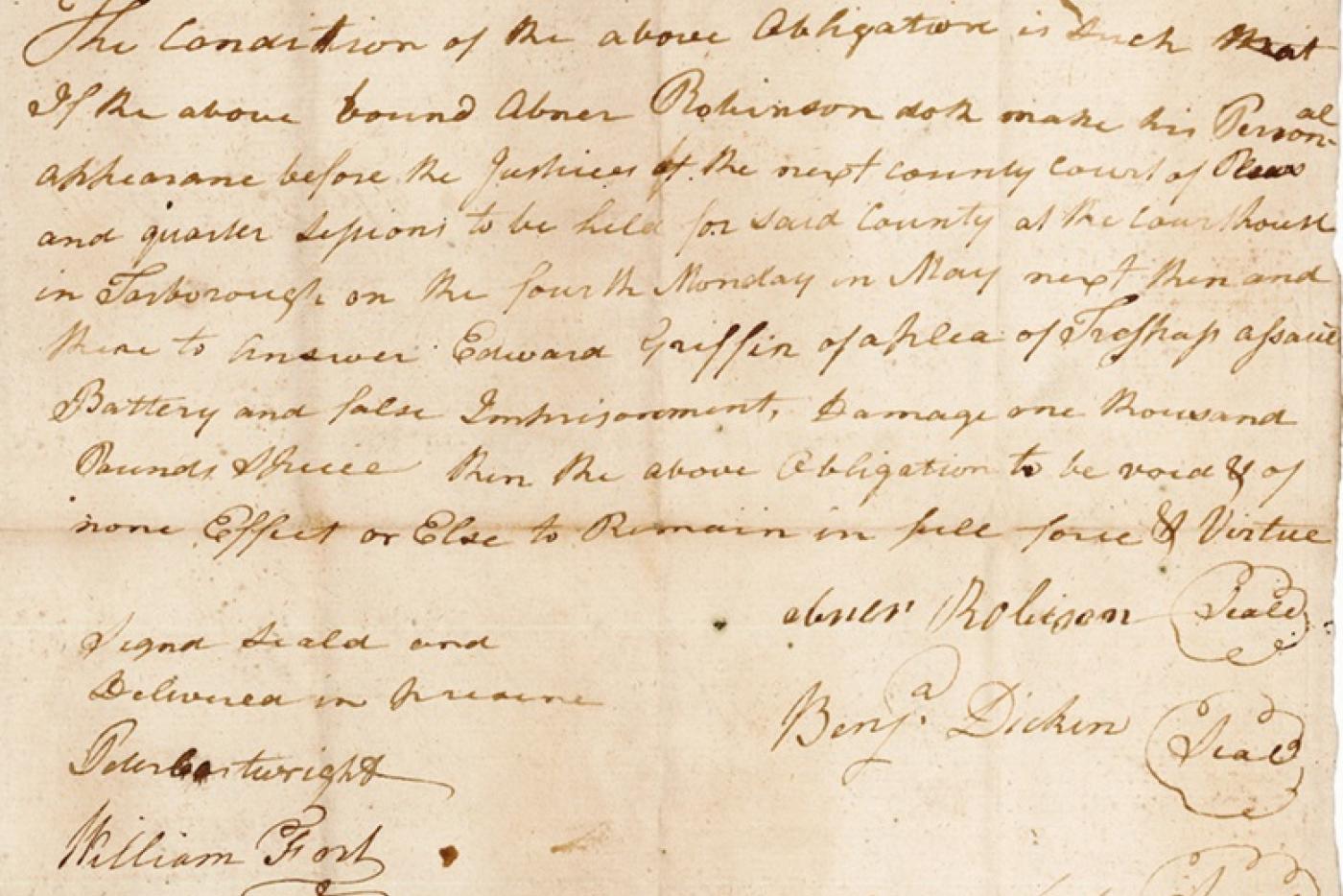
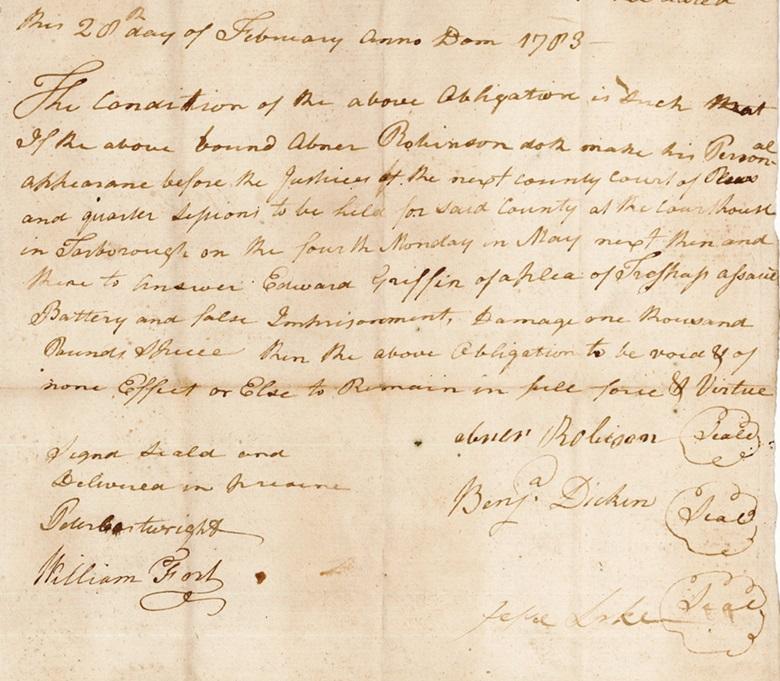
Within seven months after his honorable discharge from the Continental Line, Ned Griffin had been betrayed, brutalized, and re-enslaved. In Griffin’s words, “some Time after Your Petitioners Return he was Seized upon by said Kitchen and Sold to a Certain Abner Roberson who now holds me as a Servant.” Somehow, Griffin found help to write and submit a petition “to be released from slavery” to Edgecombe County’s Court of Pleas and Quarter Sessions for its February 25, 1783 convening. The court read the petition and referred it to the state General Assembly, and the next day the sheriff received a warrant to arrest Abner Robinson on Griffin’s charges of trespass, assault and battery, and false imprisonment. Robinson served time in prison until the county court met again in May or until he could post £2,000 bail, £1,000 of which was a required payment for damages—the largest fine imposed by the Edgecombe County Court that year. Records do not indicate that the county punished Kitchen for his role.
Before the state legislature considered the case the following year (April 1784), county officials collected testimony from William Griffin—Ned’s former enslaver—military officers, and other witnesses to his enlistment agreement, including the county sheriff and constable. After reviewing the petition and supporting documents, the General Assembly passed “An Act for Enfranchising Ned Griffin, Late the Property of William Kitchen,” concluding, “Ned Griffin . . . shall forever hereafter be in every respect . . . a freeman . . . and he is hereby enfranchised and forever delivered and discharged from the yoke of slavery.”
Ned settled near Griffin family members in Edgecombe County and eventually purchased land in 1801. Although the state had granted Ned land in Tennessee as a reward for his Continental Line service, it is unlikely he reaped those benefits. The agent appointed to distribute Ned Griffin’s land was involved in large-scale fraud associated with North Carolina’s Secretary of State, James Glasgow. In many cases, government officials and speculators profited from the land grants, rather than veterans and their heirs.
The 1800 census listed “Griffin, Edward (Mulatto)” as a free man of color with no other household members. If Ned had a relationship with an enslaved woman, a marriage would not have been legally recognized and any children would have shared their mother’s enslaved status. Although records do not show a family living with Ned, they do prove that he maintained at least some type of supportive relationship with the Griffin family. At Ned’s death in 1802, Zachariah Griffin, William and Oney’s oldest son and Ned’s neighbor, was listed in Ned’s estate papers as one of four people who had lent him money. Ned’s death near the age of 40 and his lack of legal heirs meant that no one applied to the federal government for a Revolutionary War pension in his name to expand documentation of his life and military service. Fortunately, however, the State Archives preserves his own words within his 1784 petition, as well as additional documents that help shed light on the life of a man who succeeded in fighting multiple battles for freedom.
References, Part 2
- Senate bill to give Ned Griffin his freedom, General Assembly Session Records, 1784 April-June, box 3, https://digital.ncdcr.gov/Documents/Detail/may-15-senate-bill-to-give-ned-griffin-his-freedom-petition-and-messages-only/688550
- Abner Robinson arrest warrant, February 26, 1783, and bail bond note, February 28, 1783, Edgecombe County Civil Action Papers, 1783 folder 1-2, CR.37.325.13
- Edgecombe County Court of Pleas and Quarter Sessions minutes, Feb. 25, 1783, p.4, CR.37.301. Henry Hart appointed sheriff Feb. 25, 1782, p. 3; Joseph Fort appointed constable May 26, 1783, p. 11.
- Senate bill to give Ned Griffin his freedom, General Assembly Session Records, 1784 April-June, box 3, https://digital.ncdcr.gov/Documents/Detail/may-15-senate-bill-to-give-ned-griffin-his-freedom-petition-and-messages-only/688550
- “An Act for Enfranchising Ned Griffin, Late the Property of William Kitchen,” Acts of Assembly of the State of North Carolina, April 1784, pp. 86-87. State Publications collection, State Library of N.C., https://digital.ncdcr.gov/Documents/Detail/acts-of-assembly-of-the-stat….
- Kemisa Kassa, “Griffin, Edward ‘Ned’,” NCpedia, https://www.ncpedia.org/biography/griffin-edward-ned
- For more on the Glasgow land fraud, see Russell Koonts, “’An Angel Has Fallen:’ The Glasgow Land Frauds and the Establishment of the North Carolina Supreme Court,” MA thesis, NCSU, 1995, https://www.carolana.com/NC/eBooks/An_Angel_Has_Fallen_Russell_Koonts_1995.pdf
- John Price was the agent assigned to distribute one of two Edward Griffin land grants and was eventually convicted and punished for fraudulent accounts. Revolutionary Army Accounts, Vol. III, pp. 100-108, Treasurers’ and Comptrollers’ Military Papers, State Archives of N.C.
- First Census of the United States, 1790: Edgecombe County, North Carolina, Population Schedule, p. 15, National Archives, Washington, D.C. and State Archives of N.C., accessed on ancestrylibrary.com
- Second Census of the United States, 1800: Edgecombe County, North Carolina, Population Schedule, p. 24, National Archives, Washington, D.C. and State Archives of N.C., accessed on ancestrylibrary.com.
- Edgecombe County estate records, Edward Griffin, 1802. CR.37.5, State Archives of N.C.
- Edgecombe County Deed Book 10, Feb. 24, 1801, p. 110. Henry and Love Anderson sold Edward Griffin more than 20 acres of land on the north side of “Falk’s Branch” to the Anderson property line. Accessed on US Genweb Archives, http://files.usgwarchives.net/nc/edgecombe/deeds/ebk10.txt
- Marc Anderson, Edgecombe County map project, https://andersonnc.com/edgecombe-county-map/