


In the predawn mist of February 27, 1776, the quiet banks of Moores Creek in southeastern North Carolina bore witness to a brief but consequential clash that reverberated far beyond the swampy battlefield. Though often overshadowed by later and more famous engagements, the Battle of Moores Creek Bridge was no minor skirmish. It was a strategic, political, and important triumph for the Patriot cause.
The year 1776 was bookended by two defining Patriot victories: the Battle of Moores Creek Bridge in February and the Battle of Trenton, in New Jersey, in December. While Trenton is widely celebrated for reviving the American cause during its darkest hour, Moores Creek energized the Revolution’s beginnings and proved early on that militia resistance could deliver decisive outcomes. Together, these two victories gave 1776 its revolutionary momentum from its first resistance to full commitment.
Unlike the better-known battles at Lexington and Concord, Moores Creek was not a confrontation between colonists and British redcoats. Instead, it was a civil conflict between neighbors. Loyalist forces, largely composed of Scottish Highlanders from the area of Cross Creek (modern-day Fayetteville) and backcountry Regulators loyal to the Crown, set out to join British troops expected to land at the coast.
But Patriot militia and minutemen, from New Bern to Wilmington and surrounding communities, anticipated the move. At a narrow crossing over Moores Creek, they removed planks from the bridge, greased the remaining beams, and fortified their position with earthworks and artillery on the east side of the creek.
Just before sunrise, the Loyalist force surged across Moores Creek, shouting “King George and Broadswords!” as they charged into the darkness, convinced they were on the brink of a swift and glorious victory. But their momentum faltered as they crossed the sabotaged bridge, and found its beams slick with grease. Still, they pressed forward, driven by pride and fury. A vanguard of Highlanders made it across, advancing into the shadows until they were just thirty paces from the Patriot earthworks on the far bank.
The Patriot cannon roared to life, unleashing a storm of iron that shattered the stillness and the charge. Musket fire followed in deadly rhythm, tearing through the Highlanders. On the bridge, additional Loyalists surged forward only to be swept off by the devastating cannon fire. Some plunged into the creek; others fell where they stood.
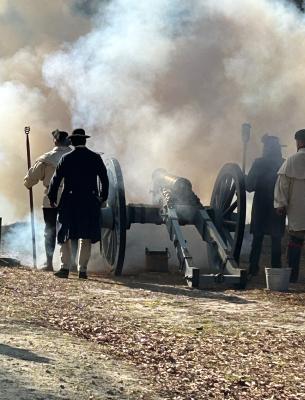
The psychological impact was immediate and overwhelming. What was meant to be a bold assault collapsed into confusion and retreat.
In about thirty minutes, more than thirty Loyalists were killed, dozens wounded, and over the next few days, several hundred captured. The Patriots, meanwhile, suffered only one combat death. The militia both outmaneuvered the enemy and ruled the battlefield with finality.
Though fought in a rural corner of North Carolina, the Battle of Moores Creek Bridge was among the largest early engagements of the Revolutionary War in terms of troop numbers. Nearly 1,000 Patriot militia and minutemen faced off against an estimated 1,600 Loyalists. For comparison, the Battle of Trenton, fought in December of the same year, involved approximately 2,400 Continental soldiers and 1,500 Hessians.
The victory at Moores Creek shattered the Loyalist infrastructure in North Carolina and forced British commanders to delay or abandon planned operations in the South. Most significantly, it gave the North Carolina Provincial Congress the confidence to act decisively. Just weeks later, on April 12, 1776, North Carolina became the first colony to officially call for independence, adopting the Halifax Resolves, a clear precursor to the Declaration of Independence.
By crushing Loyalist hopes in 1776, Patriot forces disrupted British plans to rally southern support and forced a strategic recalibration that delayed full-scale southern operations until years later.
Trenton revived the Revolution. Moores Creek energized it. These twin victories of 1776—one in the swamps of North Carolina, the other on the frozen banks of the Delaware—together framed a year of transformation. From resistance to resolve, from rebellion to revolution, Moores Creek stands not as an outlier, but as an origin.
For those eager to explore the legacy of the Battle of Moores Creek Bridge firsthand, Moores Creek National Battlefield offers insight into this consequential event in not only North Carolina history, but America’s as well. Visitors can walk the 3/4-mile history trail, tracing the footsteps of those who fought there on February 27, 1776. Everyone is encouraged to make plans for a visit 26-28 February, 2026 as the 250th anniversary of the battle is commemorated. Located in Currie, North Carolina, just 23 miles northwest of Wilmington, the park grounds are open daily from 9 AM to 5 PM, with the visitor center accessible Tuesday through Saturday. More information can be found at www.nps.gov/mocr.
Photos courtesy of the NPS, Moores Creek National Battlefield.