
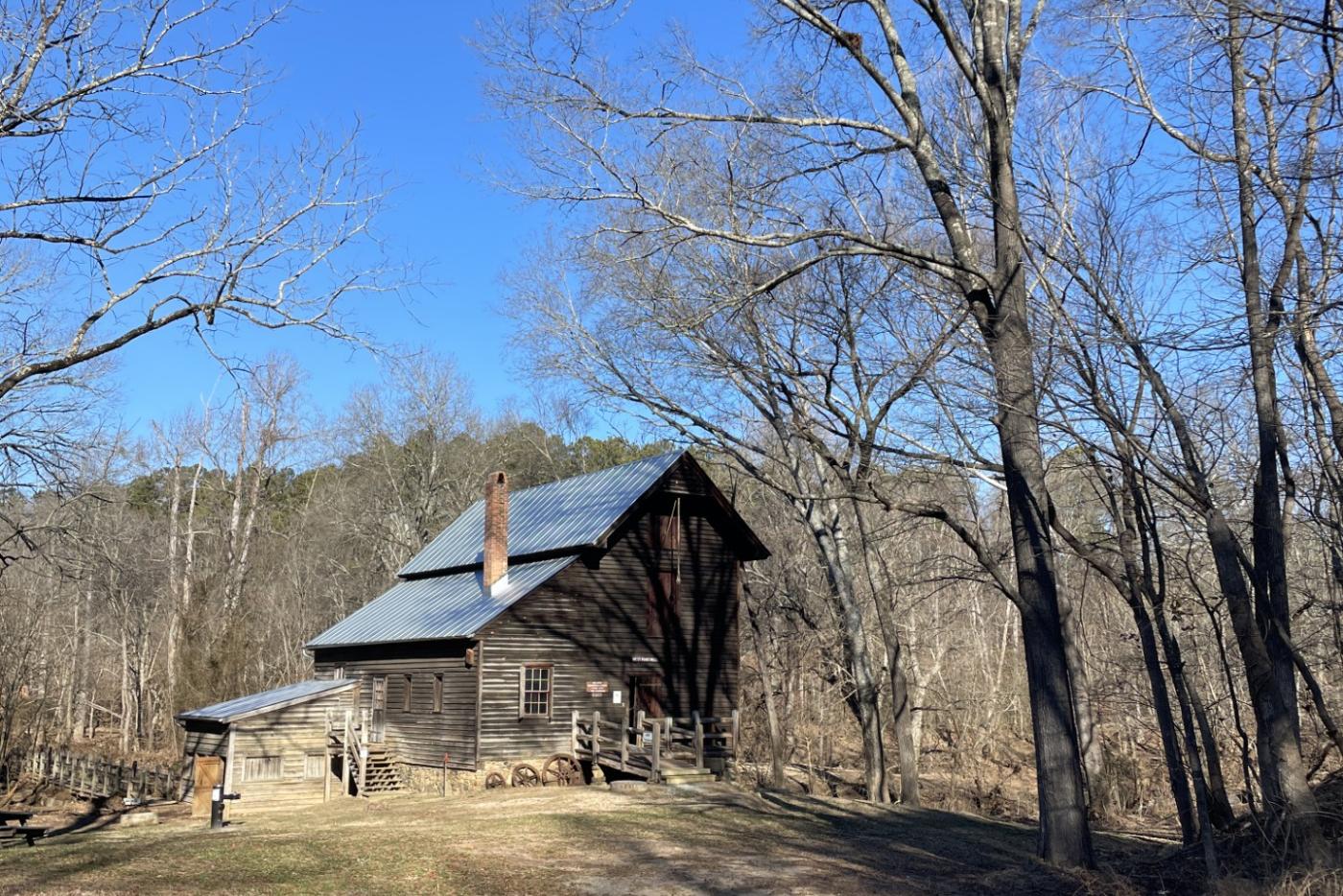
Although Durham County itself is relatively young–created out of the eastern portions of Orange County and several townships in western Wake County in 1881–the history of this region of the Piedmont is intimately tied to the economic development of the state prior to mass industrialization. West Point on the Eno, a city-owned park in Durham, North Carolina, played a role in the development of what would become Durham County and the history contained at the site is still relevant for audiences across the state today. It is at smaller, local history sites like West Point where some of the most engaging stories of resilience and resistance are found. Including these stories into the larger historical narratives presented at West Point on the Eno helps to create a more comprehensive vision of the American experience by allowing visitors to local history sites to more intimately connect themselves to the history of the places in which they live.
West Point on the Eno, like other historic sites along the roughly thirty-mile Eno River that meanders through Orange and Durham Counties until empties into Falls Lake along with the Little and Flat Rivers to form the Neuse River, has been inhabited for millennia. The river itself is named for the Eno people, an eastern Siouan-speaking nation who along with their ancestral relatives the Occaneechi and Shakori occupied the riverbanks of the Eno is small, palisaded villages of up to 150 people. By the end of the seventeenth century Europeans, mainly English colonists from Virginia, rapidly and violently displaced the Eno, Shakori, and Occaneechi from their homelands and began to establish both plantation agriculture and subsistence farms across the region throughout the eighteenth century.
West Point, as many Durhamites recognize it today, started to take shape during the American Revolution, when Charles Abercrombie and William Thetford received a land grant to construct a gristmill along the Eno River at Shoemaker’s Ford (where Roxboro Rd now crosses the Eno). Several miles upriver another miller, Michael Synnott, constructed the Eno’s first gristmill by at least 1752 and the Abercrombie/Thetford mill was meant to take advantage of the Synnott mill’s poor location at a spot along the river that lacked a proper crossing. Under the stewardship of several millers after them, the Abercrombie/Thetford mill grew into one of the largest in eastern Orange County, ultimately including roughly 300 residents at its peak. The mill itself would eventually house a general store and post office–the western-most point on the postal route, hence the name West Point–and operated a sawmill and blacksmith shop as well.
West Point’s location along the Eno River and on the road to Roxboro made it an enticing investment for the local gentry of Orange County and its ownership changed hands several times during the nineteenth century. One of the county’s most prominent citizens, Herbert Simms, purchased the mill and lands of West Point in 1817 and continued to own the property until his death in 1843. Simms, a prolific enslaver and state assemblyman, is credited along with several other Eno River millers with the creation of Orange County’s slave patrols. During his tenure as miller of West Point, Simms married the widow of another Eno River miller, Rachel Cabe McCown, in 1831. That same year, Rachel moved herself, her five children, and the roughly seventeen people she enslaved to West Point to join the Simms estate. While it's unclear how many people Simms enslaved prior to his marriage to Rachel, his estate counted thirty-six enslaved persons upon his death in 1843. Most of these men, women, and children’s names and stories have been lost to history, but the historians working at West Point have worked for several years to tell the narratives of two of the enslaved persons whose lives we can glimpse through the historical record: William McCown and his wife Elizabeth.
William and Elizabeth (known as Dink and Betsy, respectively) McCown’s lives present a common problem that many local history sites in North Carolina face when dealing with enslaved peoples: a lack of recorded history from the perspective of the enslaved. Outside of scattered references in government documents, Dink and Betsy’s no-doubt rich personal lives and struggles in both bondage and freedom are largely unknown to us. Prior to the Civil War we know that Dink was born into bondage in 1833 and Betsy in 1837. Dink’s mother was enslaved by Moses McCown, Rachel’s first husband, and was likely part of the estate she transferred to West Point when she married Herbert Simms. Not much is known about Betsy prior to her marriage to Dink in 1857. In fact, her birth year is only confirmed by using Census records from 1870 and working backwards.
Due to the many holes and questions about the daily lives of Dink, Betsy, and the other enslaved persons who toiled at West Point, historians must rely on secondary sources and the words of men like Herbert Simms to fill in the gaps. Simms constantly complained about the work ethic of the people he enslaved and was particularly unkind in his writing to the children at West Point–both white and black–who he viewed as a burden on his productivity. All of this was made worse by the fact that, according to court documents filed during the protracted legal battle over the ownership of his estate after his death, Simms “refused to keep…guardianship records.”
Most of the records that directly reference Dink, Betsy, and their children understandably come from after the Civil War, when emancipation under the Thirteenth Amendment created more visibility for African Americans in the South. It is during this period of American history, particularly the period known as Congressional Reconstruction (1867-1876), that records about Dink and Betsy’s post-emancipation life become clearer. Thanks in large part to records kept by the Freedman’s Bureau, we know that Dink and Betsy married in 1857, but their marriage was not legally recognized until July of 1866. The legalization of their marriage is an incredibly important detail that we can glean from the historical record because it allows us to interpret the story of their lives post-emancipation. Having a legally recognized marriage certificate meant that their children who were born into enslavement would be recognized by the state as theirs and would not be sent off into the overburdened orphanage system that ballooned after the Civil War. Records like these and others help historians in North Carolina to understand the lives of those that are oftentimes overlooked in larger narratives of the period.
These records also help local historians to discover the daily lives of enslaved peoples. From the 1870 Census, we know that Dink was employed as a miller and lived either directly next to, or close by to John Cabe McCown–the man who enslaved him and his family. Dink was employed at the West Point Mill after the war, earning an average salary for the work, roughly $150 annually. Betsy’s occupation, unlike many other formerly enslaved women during the period, is listed as “keeping house,” which gives us some insight into the economic conditions experienced by the McCowns. This is not to say that Betsy was not employed as a laundress or maid for white families in the area, but it does suggest that Dink and Betsy had a degree of financial independence such that she could afford to stay home with her young children (they had five by 1870) and generate income for the family through the making of small textile products, baskets, or crops from their garden. Using these sources and others helps us to construct a narrative of how this family endured the horrors of enslavement and persisted through Reconstruction to build a life for themselves at West Point on the Eno and later Durham where they moved to sometime after 1880.
Dink and Betsy’s story is one of resilience and resistance in the face of overwhelming social, political, and cultural adversity. Born into bondage, forced to labor under the yolk of enslavement, and eventually persevering through emancipation, telling the story of the other McCowns of West Point allows North Carolinians to expand the definition of whose stories are preserved at local historical sites.
None of the research presented in this post would be possible without the tireless work of the historians of West Point on the Eno but in particular Jessica A. Bandel and her article in the Eno Journal “Through the Eyes of ‘Dink’: A Reexamination of the History of West Point on the Eno”
Photo provided by West Point on the Eno.
Work Cited
Anderson, Jean Bradley. Durham County: A History of Durham County, North Carolina. Duke University Press, 2011.
Bandel, Jessica A. “Through the Eyes of ‘Dink’: A Reexamination of the History of West Point on the Eno.” Eno Journal: Ribbons of Color Along the Eno River, The history of People of Color Living on the Eno 10, no. 2 (2022): 34-49.
Davis, Jr., R. P. Stephen, Patrick C. Livingood, H. Tradwick Ward, and Vincas P. Steponaitis, eds. Excavating Occaneechi Town: Archaeology of an Eighteenth-Century Indian Village in North Carolina. University of North Carolina Press, second web edition, last updated March 2021. DOI 10.5149/9781469666310_Davis.
DigitalNC.org
Edwards, Laura F. “’The Marriage Covenant Is at the Foundation of All Our Rights’: The Politics of Slave Marriages in North Carolina after Emancipation.” Law and History Review 14, no. 1 (Spring 1992): 81-124.
Glymph, Thavolia. Out of the House of Bondage: The Transformation of the Plantation Household. Cambridge University Press, 2008.
Holt, Sharon Ann. “Making Freedom Pay: Freedpeople Working for Themselves, North Carolina, 1865-1900.” Journal of Southern History 60, no. 2 (May 1994): 229-262.
Kelley, Blair L. M. Black Folk: The Roots of the Black Working Class. Liveright, 2023.
Research Laboratories of Archaeology, University of North Carolina at Chapel Hill. “Central Piedmont,” Ancient North Carolinians: A Virtual Museum of North Carolina Archaeology.
Rice, James D. “Bacon’s Rebellion in Indian Country.” Journal of American History 101, no. 3 (December 2014): 726-750.